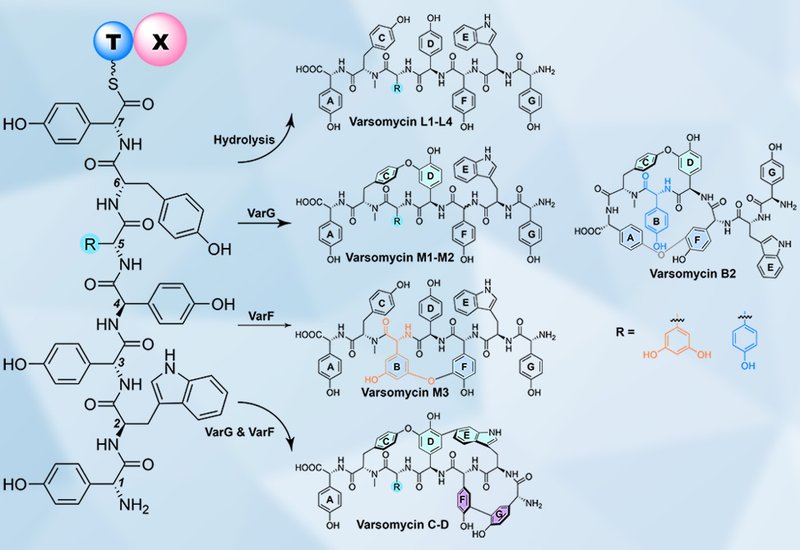
Glycopeptide antibiotics, GPAs, are last-resort medicines against methicillin-resistant Staphylococcus aureus, MRSA, and vancomycin-resistant enterococci. Their activity depends on a rigid, cup-shaped three-dimensional scaffold held together by biaryl cross-links, each installed by a dedicated cytochrome P450 enzyme during non-ribosomal peptide assembly. Type I–IV GPAs share a conserved A–B, C–O–D, and D–O–E cross-link pattern, and the recently characterized type V compounds, including the varsomycins, added an F–G biphenyl ring to that inventory. The P450 responsible for forging that F–G linkage remained unidentified, leaving a gap in the biosynthetic logic of this antibiotic class.
Researchers in the Xu Lab at the Tianjin Institute of Industrial Biotechnology, Chinese Academy of Sciences, published in Organic Letters, disrupted the two candidate P450 genes, varF and varG, individually and in combination from the varsomycin biosynthetic gene cluster, then expressed each mutant cluster heterologously in Streptomyces coelicolor M1154. By supplying accessory plasmids that encode the transcriptional activator StaQ and the biosynthetic machinery for 4-hydroxyphenylglycine, Hpg, and 3,5-dihydroxyphenylglycine, Dpg, the team produced two sets of varsomycin derivatives that differ at position 5. They characterized all products by high-resolution time-of-flight mass spectrometry, HR-MS/MS fragmentation, and 1D and 2D NMR spectroscopy, scaling fermentations to 40 L where necessary for sufficient material.
Metabolic profiling revealed the expected linear and monocyclic derivatives. The ΔvarF mutant accumulated C–O–D cross-linked products M1 and M2, while the ΔvarG and ΔvarFG mutants accumulated linear products L1 and L2, establishing that VarG installs the C–O–D ring and VarF installs the D–E ring in the sequence C–O–D (VarG) then D–E (VarF). Two minor products, M3 and B2, proved more consequential. HR-MS/MS of M3 identified daughter ions at m/z 417.1079, 445.1033, and 462.1318, consistent with a cross-link between Hpg3 and Dpg5. NOESY correlations in the 2D NMR data confirmed a Hpg3–O–Dpg5 biphenyl-ether linkage, a macrocyclic ring spanning positions 3 and 5 that had no prior precedent across all GPA structural classes. For B2, HR-MS/MS daughter ions at m/z 788.2533 and 771.2297 supported a second cross-link between Hpg3 and Hpg7, a putative A–O–F ring that extends the known biaryl inventory further still. During purification of B2, a co-eluting compound, M4, was isolated and shown by NMR and chiral derivatization using (S)-N-(4-nitrophenoxycarbonyl)phenylalanine methoxyethyl ester to carry S-Hpg at position 3 rather than the R configuration seen in all other varsomycins, indicating that the epimerization domain in module 3 accepts both epimers, albeit with lower efficiency for the S-configured substrate.
Structure–activity relationship profiling across 18 indicator strains showed that linear and monocyclic varsomycins almost entirely lost antimicrobial activity, mirroring the outcome of P450 disruption in complestatin and vancomycin biosynthetic gene clusters. Among all derivatives, M3 was the only compound to retain meaningful potency, with minimum inhibitory concentrations of 8–32 μg/mL against Bacillus subtilis 168, multiple Staphylococcus aureus strains including MRSA, Listeria monocytogenes, and Streptococcus pyogenes. That activity profile implicates the Hpg3–O–Dpg5 ring as a functionally significant structural element and places Dpg5 at the center of the antimicrobial pharmacophore in this derivative series.
The discovery that VarF, an OxyA-family P450, can catalyze formation of the Hpg3–O–Dpg5 cross-link in addition to its canonical D–E ring makes it the first OxyA homologue documented to build multiple biaryl linkages in GPA biosynthesis. Combined with the substrate flexibility at position 3 and the capacity to accommodate either Hpg or Dpg at position 5, these results show that the biaryl cross-link space of type V GPAs is broader than previously recognized. The authors note that in vitro biochemical studies will be needed to resolve the precise mechanism by which these non-canonical rings form. The Hpg3–O–Dpg5 linkage in M3, which confers activity on an otherwise inactive linear scaffold, provides a starting point for biosynthetic engineering aimed at generating GPA derivatives with improved potency against drug-resistant pathogens.